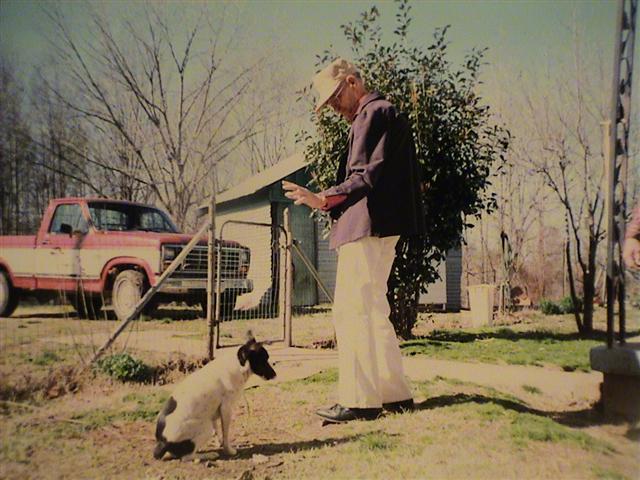
Thursday, August 11, 2011

Henry T. Moxley, part two

Henry T. Moxley married Martha Arminta Sibley about 1868 in probably Franklin County, Alabama.

Martha, or "Mint" as she was sometimes called, was the daughter of Thomas Tanner Sibley and Martha Anne McCollum.  She was born in April 1852 in Franklin County, Alabama.

Henry and Martha used family names in the naming of their children, and this pattern is also seen in some of their grandchildren.  For instance, Milus (or Milas, Milus) appears to be a frequently used family name.   Martha Sibley Moxley had a brother named Milas McCollum Sibley, and I'm sure that Martha's grandson, Henry Milus Moxley, was named for his uncle.  (Note:  Sometimes Henry Milus is found as Minus instead, but this appears to be incorrect although possibly the name was changed inadvertently.)

Henry and Martha's son, Thomas Austin Moxley, was most likely named for each of his grandfathers:  Thomas Sibley and Austin Smith Moxley.  

Emily C. Moxley Holley was named for her grandmother, Emily C. Sims Moxley, but I don't know what the middle initial "C" stands for with either female.   Martha Sibley had a sister named Caroline.

Joseph McCollum Moxley, another son of Henry and Martha's, was named for Henry's brother Joseph plus Martha's mother's maiden name of McCollum.     James Richard Moxley was named for Henry's brother, Richard, with Richard being a well-used given name in the Moxley family.

Perhaps the most intriguing names are those of Addison, Richard, Joseph and Henry Thomas because not only do these names show up in Henry T. Moxley's family as either sons or brothers, but these men were supposedly all brothers of Austin Moxley, and sons of Christopher Moxley and Jane Smith in King George County, Virginia.   The consistent use of these names through several generations, and the link to Virginia, appears to connect our Austin Smith Moxley to this family.   A further tie-in is that Jane Smith Moxley had a brother named Austin Smith, as evidenced by the 1799 will of Thomas Smith in King George County, Virginia.   The only "red flag" that I see is that Jane Smith Moxley, and her husband Christopher, were born about 1775, while our Austin Smith Moxley was born in 1825, meaning they would have become parents around the age of 50.  Possible, but not too common.  Maybe our Austin was their grandson, but there are too many solid points of evidence to ignore the link to this Virginia family as ancestors of Henry Thomas Moxley.

Ervin Moxley, Henry's grandson, shared some family history with Cousin Don Dulaney a couple of years ago.  In this history, Henry's son Luther said that his father told him many times that the Moxleys were descendants of Captain John Smith of Virginia, coming to America from a town in England called Moxley.   Indeed, there is a Moxley town in West Midlands, United Kingdom, but the town does not appear to be older than the early 1800's. 

Wednesday, August 10, 2011

Henry T. Moxley, part one

Henry T. Moxley was born July 12, 1844, and died May 13, 1928.  According to his death certificate, there was no doctor attending Henry when he died although "it was said he had Rheumatism."  Interviews with several of Henry's grandchildren in 2009 provided additional information about his death.    It seems that Henry was an excellent squirrel and rabbit hunter.   Even in his later years, Henry was a good shot.  After the death of Henry's second wife and after he got on up in years (he was nearly 84 when he died), Henry took turns living with some of his children.  Lucky for us, because his grandchildren have wonderful memories from those days of their grandfather that they have passed along to us.  Because of his advanced age, Henry couldn't work in the fields with the rest of the family, but he could still hunt and put game on the table, particularly rabbit and squirrel.   Henry had been rabbit hunting during a cold spell, became ill, and died a few days later.   Place of death on his death certificate:  Bounds Crossroads in Itawamba County.

Henry's death certificate confirms that he was the son of Austin Moxley of Virginia, and that his mother's maiden name was Sims, of Alabama.     The certificate doesn't tell us what the middle initial "T" stands for, and I've not found any other supporting document, but it is generally believed that his full name was Henry Thomas Moxley. 

Austin Moxley was a schoolteacher by profession.    His great-grandchildren have recounted how Austin's son Henry gave the land for Moxley Schoolhouse in northeastern Itawamba County.    Henry's son, Luther, was a schoolteacher at various schools throughout the county before joining the ministry.  Henry's son-in-law, Professor John F. Williams (husband of Florence), was a well-respected educator.  Another son-in-law, Joseph "Joe" Holley (husband of Emily), came from the well-known Holley family of teachers in Itawamba County.  Whether Henry was a schoolteacher himself is not clear.   It is thought that Henry once taught at Moxley School; his death certificate lists "farmer" as occupation.  Henry was said by his grandchildren to have been "smart."

In addition to being smart, Henry apparently was a good story-teller and had a sense of humor as well.   Grandchildren would gather at his knee to listen to his stories.  Henry told them that they were part Indian and entertained them with tales of his adventures with boats and sails "when he was in Virginia."  

Henry also supposedly served during the Civil War.  Could he have been in the Navy?  Some independent records indicate that he was a Unionist, enlisting in the 1st Alabama Cavalry of the Union Army.  I've found no source documents to support this assertion.  There was a Henry Moxley who was an assistant engineer in Union Admiral Farragut's attack on Fort Gaines on Dauphin Island in Mobile Bay.  Could this be our Henry, serving in the Union Navy?  Seems a bit unlikely.

There also is a record of a Henry Moxley who enlisted at Memphis with the 2nd Tennessee Regiment CSA.  We know that Henry's mother remarried in Madison County, Tennessee (just east of Shelby County and Memphis) in 1866, and that Henry's brother Joseph was married there in 1868.    Henry was living in Madison County in 1866 when he served as a bondsman for his mother's remarriage.  Maybe the Moxleys left the volatile Northwest Alabama area where tensions ran high between Unionists and Confederate supporters. 

One other possible record for Civil War service has been found.  An "H" Moxley enlisted as a private in Moreland's Regiment Cavalry, Company F.  From what I've learned about Moreland's Regiment, it was led by Col. Micajah Moreland of Tishomingo County, and many Alabama men enlisted just over the state line in Mississippi.  The geographical location of this Moxley enlistee seems to be more appropriate for our Henry.

There is also the possibility that our Henry could have been "persuaded" to join the Confederate cause, then later changed over to the Union army or navy.  This happened quite often.  More research is needed to determine if Henry T. Moxley served in the Civil War, and in which company/regiment, and for which side.   Henry would have been 17 years old at the start of the war, and it certainly seems likely that he would have seen service, especially a bit later on in the war.   In the South, the conscriptive draft made it difficult, if not impossible, for young men to avoid service, and the local Home Guard units were often charged with making sure every able-bodied male enlisted.

Wouldn't it be fun though, to discover that Henry served in the Union Navy? What a story!

Monday, August 8, 2011

Austin S. Moxley - what happened?

The Moxley name is not a common one in our area.  It is fair to say that if you live in NE Mississippi or NW Alabama, and have a Moxley ancestor, you probably are a descendant of Austin Smith Moxley.  Austin appears to have been the only Moxley who settled in this part of the country.  What brought him so far from his native Virginia?  We will probably never know for sure.  Like so many of his contemporaries, Austin was probably drawn by the lure of newly settled lands where opportunities and fresh starts availed.

We know Austin was an educated man.  The 1850 census for Fayette County indicated "schoolteacher" as Austin's occupation.    He left generations of descendants who were educators as well.  Moxley School in eastern Itawamba County received its name from sons and grandchildren who taught school.

Austin apparently was well-liked and well-respected.   Surviving records show that he was elected Justice of the Peace at least twice.  

Unfortunately, Austin's time on earth was not long; he died at the age of 30 of unknown circumstances, leaving a widow, four sons and a daughter.  Did he die of natural causes?  An illness?  Probate records include bills to the estate for medical services that indicate Austin was under a doctor's care for most of 1855, with daily medical visits from October 14 through October 21, when a visit to the "death bed" was referenced.  It appears that Austin died on October 21, 1855 from a chronic disease or illness rather than a sudden death.

A few records survived the disastrous 1866 fire at the Fayette County courthouse as well as other fires that destroyed most of the county's early public records.  In addition to the 1846 and 1847 officers bonds that I posted earlier on this blog, one 1848 deed record and several pages of probate records were found for Austin S. Moxley.

On December 15, 1848, Austin S. Moxley and his wife, Emily C. (Sims) Moxley, for five dollars, conveyed one square acre of land lying in the Southwest corner of the East half of Section 16, Township 15, Range 16 to Arthur Young.   The conveyance deed was witnessed by Isaac Green, Justice of the Peace, and recorded on January 9, 1849 in Record Book E.O. Vol. 6, pages 136 and 137 by John C. Moore, Clerk.

No will has been found for Austin.  Probate records exist at the Fayette County courthouse although they appear to be incomplete.     I doubt a will was prepared even though records seem to show that Austin would had have time to get his finances in order.  The reason I suspect there was no will is that an Administrator of the Estate of Austin S. Moxley was not appointed until September 1856 at which time an inventory of the previously "unadministered" estate revealed notes and accounts due to Moxley totaling $327.34.  Unfortunately, there were claims against the estate of $507.33 filed during the January 1857 term of court, and the administrator of Moxley's estate, Thomas P. McConnell, asked the court to declare the estate insolvent. 

The Letters of Administration appointing Thomas P. McConnell as administrator, and the subsequently filed inventory, schedules and the final settlement are recorded in Probate Court Record Book 1-A, pages 123-126.   The same record book, on pages 445-454, includes details of the receipts and claims of the estate, dated from 1856 through February 1857.

From here, the records appear confusing, and this is why I believe there are missing probate records.  In March 1857, a Final Settlement appears to have been filed by Thomas P. McConnell, administrator, on behalf of the A. S. Moxley Estate.  Yet, in 1861 there is yet another filing for the estate, found in Probate Record Book 11, pages 18-19, of a partial settlement.  In addition, at the same time, R. Allen Smith is appointed Guardian ad Litem to protect the interest of the minors at a hearing to be held August 1861.    This is the last probate record found for the Estate of Austin S. Moxley.    No minors were named in the record, and no record or minutes were found for the subsequent August hearing. 

In the 1860 census, Austin's widow and children were living in the household of John A. "Stuckey" in Franklin County, Alabama.  Apparently, the Moxley family had left Fayette County and moved northward to Franklin.   Mrs. Emily C. Moxley, Austin's widow, and John A. "Sturkie" were married April 10, 1866 in Madison County, Tennessee.  Emily's oldest son Henry T. Moxley, age 22, served as bondsman on the marriage license.  

Emily Moxley Sturkey moved to Arkansas by 1880 where she, her husband John, son Drury and granddaughter "E. C." were listed on the Cross County census in the Brushy Lake township.    By 1890, Emily is once again widowed.  Her name shows up in the 1890 Tax List for Itawamba County:  Mrs. E. C. Sturkey.   She last appears in the records in the 1910 census, living with her son Henry.  She was 83.  No death record has been found for her.

Saturday, August 6, 2011

My Dog Skip

 By Cousin Don Dulaney  

    Skip was the last dog I remember Papaw Dulaney owning. His attention from the family was the result of his affection for corncobs.  Papaw had trained him to retrieve or find one, and it provided much entertainment at the Dulaney family gatherings. However, what I remember was the gleam in Papaw's eyes when he focused on the little fiest dog. Seems like Papaw was happiest when he was working with animals, and I believe that his love for them came from his dad James (Jim) Henry Dulaney. Jim was a country veterinarian, and Lawrence picked up the trade and was the last of a breed in Itawamba County. All of Lawrence’s grandchildren at one time or another accompanied Lawrence on a visit to doctor an animal. My best memory would probably have to be the first time I saw him insert his arm, up to his shoulder, into a heifer to turn a breached calf about to be born. This was quite a sight for a nine year old little boy.
    I have often wondered why every old farmer had a dog. After I started thinking about Skip and Lawrence together, it started to come into focus. Lawrence wowed all of us with his squirrel hunting skills and his ability to not only see talent in his choice of dogs, but how to train that dog to perform the given task. Even today, during whatever brief encounters I have with my Dulaney cousins, those squirrel hunting trips with Lawrence and his squirrel dogs are always a topic. You never shoot a nest.  If the tree is hollow, you can always smoke the squirrel out.  The art of having someone “turn the squirrel” by walking around the tree, and the act of shaking vines - these are just a few of the things Lawrence left in my generation’s memories. I was much older, and Lawrence had passed on, before I realized the true values Lawrence found in these little creatures.
    A dog was just as important as the Jersey milk cow or the hog raised for slaughter. To understand Skip's true value, you have to picture the family farm that provided the character our dear Ole Itawamba has today. For example, the trip to the barn was an every morning and every afternoon event, to milk the cow and gather hen eggs. Like many farms, the path to the barn was littered with old iron plows, or maybe stacks of old wood, or maybe empty canning jars that Johnson grass had overtaken. Skip, our fearless hero, spent much of his time putting himself in harm's way, sniffing out dangers such as snakes or controlling the rat population. The farms were dark at night with scarce lighting.  However, the family dog provided not only an alarm to the sleeping farmer, he also kept danger at bay until the farmer could assess the situation. If it was helping put meat on the table, such as deep fried squirrel head, or going head-to-head with a rattlesnake, a dog truly was farmer’s best friend.   

    Lawrence did as his father and grandfather did; he became a master in finding the full potential in his dogs. The value Lawrence found in Skip involved all these things, however the gleam in his eye came from unquestioned loyalty and from the nonjudgmental ear little Skip provided, not to mention the one quality Lawrence probably valued above all others  -- that was the fact that Ole Skip never talked back.

Friday, August 5, 2011

Country Roads Take Me Home

On a drive through the back roads of Itawamba County, Mississippi and Marion County, Alabama this past Wednesday afternoon, Mike and I were exposed to some mighty pretty scenery.   We were delighted to find this wonderfully preserved dog trot, a perfect example of a typical Southern home a hundred years ago.  The house and grounds, even the out-buildings (every Southern farm had several...in addition to the barn you'd likely find chicken house, smoke house, outhouse, corn crib, pig pen etc) are being meticulously kept up.  No one appears to be living in the house, but I can just imagine someone in the family lovingly taking care of the property.    It was a beautiful old homeplace in northern Marion County.


Mike and I like to meander on country roads, and until the advent of smart-phone technology and the use of GPS on our cell phones, we'd usually get lost.   We still do when the signal from the nearest tower disappears, and I no longer have use of my cell phone and its useful GPS mapping application (as happened on Thursday during our drive through the Sipsey Wilderness and Bankhead National Forest, but that's another story).   We weren't lost however when I snapped the photograph below.   The land along the MS-AL state line between Itawamba-Marion and Itawamba-Lamar and Monroe-Lamar counties is amazingly beautiful.  This area is very remote with very few (good) "back" roads connecting the counties, but if you have the time to meander you will be rewarded with great scenery.  I snapped the photograph below not long after we crossed Hurricane Creek into Marion County.  There are many beautiful coves and pastures and bottom lands if you just get out and wander around.  You could probably say I was in between families at the time the photo was made - George Emerson Robinson on one side of the state line on Cotton Gin Road, and Isham James Loyd in Bull Mountain bottom on the other side in Alabama, and Jesse B. Davis smack dab in the middle around the corner from Providence Church.    Go a little further south, and there's William T. Bishop along the state line in Bexar.  I like to think that maybe they were watching and smiling.

Thursday, July 28, 2011

Austin S. Moxley

The "find of the day" as Cousin Don Dulaney would say, were the records for Austin Smith Moxley, that were just waiting to be discovered in the Fayette County courthouse.  Fayette County was organized in 1824, one of the earlier counties in the state of Alabama which itself wasn't created until 1819.  A disastrous courthouse fire in 1866 destroyed most of the early records for the county, and later fires also resulted in a loss of records.   So it is a small wonder that we found the records we did for A. S. Moxley.

All of the Moxleys in Itawamba and surrounding counties are descended from Austin Smith Moxley, and his wife Emily C. Sims, through their son Henry Thomas Moxley.  Another son, Drury, lived in Itawamba County but had no children.   Son Joseph also lived in Itawamba County, but it appears that he also had no surviving children from his two marriages [UPDATE:  Joseph did have several children from his first marriage, but these lived in Shelby County, Tennessee.]   Son Richard moved to Arkansas, and no information is known about him.   Austin and Emily had one daughter, Mary, who apparently died before 1880. 

Back to Austin Smith Moxley.... he was a Virginia native, probably the son or grandson of Christopher Moxley and Jane Smith of King George County.   Austin appears to be in Marion County, Alabama in the 1840 census, listed as A. S. Moxley, with an older female (mother? sister? and several small children).    He married Emily C. Sims about 1843, and their first child Henry Thomas Moxley was born July 12, 1844. 

One of the earliest, if not THE earliest, surviving record book at the Fayette County courthouse is Records of County Officers Bonds.    On page 85, an officer's bond was recorded which indicated Austin S. Moxley was elected April 25, 1846 as Justice of the Peace.    On the bond with Austin were Joseph P. Henry, James A. Givens and John R. Kirkland.  On page 132, another bond was recorded March 30, 1847 for Austin S. Moxley as Justice of the Peace.

In the 1850 census, we find Austin and his family enumerated in Fayette County.

1850 Census
Fayette County, Alabama
Beat 2 Division 16
(living next to Jesse Pennington and other Pennington families!)
A. S. Moxley 25 VA 'schoolteacher'
Emily C. 24 AL
Henry T. 6 AL
Jasper (this is Joseph) D. 4 AL


Also in 1850, the Slave Schedule for that year showed a nine year old black male owned by A. S. Moxley.

Land Patent records on file with the Bureau of Land Management show an 1852 patent issued to Austin S. "Mosley" for a tract of land located in present-day Lamar County, then part of Fayette County.   Based on the land's description, it was situated in the Bedford community north of the town of Vernon.

So just who was this guy?  Austin S. Moxley was my husband's GGGG grandfather.  Austin's granddaughter, Alice C. Moxley, married Thomas A. "Bunt" Dulaney, and their granddaughter is Shirley Dulaney Mills.

More to come on another post.

Wednesday, July 27, 2011

A Trip to Fayette

Yesterday was a beautiful day, hot yes, but a nice day nonetheless.  Momma and I were up early to drive over from Fulton to Fayette, the county seat of Fayette County, Alabama.   We both were surprised at the neat little town of Fayette.  The leaders and citizens have done much to improve and update their downtown area... very impressive.  After a morning in the records room at the courthouse, below, we had very good lunch at Ricky G's Diner before heading to the county's genealogical resources on the second floor of the library.    We didn't mean to stumble upon the headquarters for Golden Eagle Syrup company, but lookee here we did!  Long-time readers of this blog will remember my post nearly three years ago about this famous southern biscuit syrup.   Momma wants to go back later for a tour of the facilities!   The old brick building is about a block away from the old railroad depot.

Friday, July 22, 2011

Fessie's Birthday

     
Fessie Manuel Pennington was born 99 years ago today, July 22nd.  I couldn't let the day get by without a remembrance of him.   Above is a picture of Fessie with his first grandchild.... me!  I am a July baby too!   Below is the earliest photo we have of Fessie, taken about 1914.  He sure was a cute baby.


Wednesday, June 29, 2011

Tornado picture found - Alice V. Moxley

The tornadoes that struck Mississippi and Alabama and Tennessee on April 27 unleashed and released hundreds, if not thousands, of family photos and mementos.    A page was set up on Facebook as a clearinghouse for these lost articles, and several photographs have been reunited with their owner.  This particular photograph, while identified, has not been discovered by its original owner.    Here's a link to the Facebook page that contains the found photographs and related information.

Mrs. Alice V. Moxley, wife of Luther A. Moxley, was born Alice Victoria Stanphill, daughter of John William Stanphill and Araminta Williamson.  Along with her husband Luther, Alice served as a minister in the Church of God of Prophecy.  In the 1930 census, both Luther and Alice were listed as ministers.

1930 Census
Warren County, Tennessee
Third Civil District
L. A. Moxley 36 MS AL AL minister, Prostestant church, married at age 21, war veteran
Alice V. 27 MS AL MS, minister, church
Elmer A. 5 MS son

This family is actually enumerated twice in this census.  The handwriting is different for each one, and both indicate that Alice Moxley was a minister.  The second enumeration for Alice reads "minister and pastor."


Luther's sister was also named Alice.  She was my husband's GG grandmother, married to Thomas "Bunt" Dulaney.

Monday, June 27, 2011

William Gray Woodard family


This photograph of the William Gray Woodard family was shared with me by Fay Wood, William's great-granddaughter, following a post about Susan Woodard Senter.  Susan and William were siblings, children of Jesse Woodard and Sarah Partin.   Both Jesse and Sarah were born in North Carolina, Jesse about 1808 and Sarah about 1817.    Sarah may have been sister to Gray Partin Sr. ..... note that she named one of her sons William Gray Woodard.

William Gray Woodard was born June 8, 1851 in Itawamba County and died October 14 1920 in Yell County, Arkansas.  He married Sarah Francis Guyton on September 26, 1872 in Itawamba County.  Pictured with William and Sarah in the above photograph are their three youngest children, from left:  Grady Miles, Myrtle, Audie Bell.  Fay's grandfather, John Henry Lee Woodard, is not pictured here.

Fay is trying to determine the parents of Jesse Woodard.  If anyone has any information, please get in touch with me and I'll send it along to Fay.    I also have an interest in this family:  Jesse's daughter, Isabella Jeanette Woodard, married Joseph Potts, brother of my GGG grandfather, Jesse H. Potts.   The Woodards and Pottses appear to be in different corners of the county, with Jesse Woodard up around Mud Creek and Jesse Potts down around Carolina.   All help appreciated.

Friday, June 24, 2011

Take me back to the Southland.....

Ever have a song just stuck in your head?  I've had that recently.   Several years ago, Mike and I heard a song on public radio... actually two songs played back to back.   A renewed interest in bluegrass brought the song(s) to mind.    Both are very touching, very sad songs that will send chills down your spine or put goosebumps on your arms, especially when played together.  

I'm reminded of George Washington Warren, son of S. John Warren and his second wife, Sarah Robinson, who was Mike's GGG grandfather (his great-grandmother Laura Bertha Warren Dulaney's grandfather).  G. W. Warren served in Company F, 24th Miss. Infantry, otherwise known as Cummings Grays after M. C. Cummings, who organized the company out of Itawamba County volunteers.  Company F was commanded by a fellow Itawambian, Captain B. F. Toomer.  
 Post Options
After serving in battles at Corinth, MS; Cave Hill, KY; Murfreesboro, TN; and Chickamauga, GA, George W. Warren's luck ran out.  On November 24, 1863, he was captured at the Battle of Lookout Mountain, subsequently sent to a Union prison at Louisville, Kentucky and later transferred to the newly-opened Rock Island POW Camp in Illinois where he died on December 20, 1864.  POW records indicate he died of phtheris pulmonaris, a fancy term for consumption, also known as tuberculosis of the lungs.  Most likely, it was pneumonia that killed George Washington Warren.

For additional information about a Confederate's soldier's experience at Rock Island Prison Camp, you can read this first-hand account written by Charles Wright.    Hunger, meager clothing, and poor living conditions contributed to many unnecessary deaths.  Disease was rampant; a smallpox epidemic killed over 600 prisoners in just three months.   George died leaving a wife, the former Margaret Digby, and two small children, Nancy and John Ed Warren.

The first song is Legend of the Rebel Soldier, written by Charlie Moore and popularized by the bluegrass band The Country Gentlemen in 1971.   Below are the words, but you can hear the song on You Tube here at this link.

In a dreary Yankee prison
Where a rebel soldier lay
By his side there stood a preacher
Ere his soul should pass away
And he faintly whispered: Parson
As he clutched him by the hand
Oh, parson, tell me quickly
Will my soul pass through the Southland?

Will my soul pass through the Southland
Through the old Virginia grants
Will I see the hills of Georgia
And the green fields of Alabam?
Will I see the little church house
Where I pledged my heart and hand
Oh, parson, tell me quickly
Will my soul pass through the Southland?

Was for loving dear old Dixie
In this dreary cell I lie
Was for loving dear old Dixie
In this northern state I die
Will you see my little daughter
Will you make her understand
Oh, parson, tell me quickly
Will my soul pass through the Southland?

Then the rebel soldier died

We had a difficult time finding the second song, probably hindered by the fact that we didn't know the title, which eventually was discovered to be Rebel's Last Request.  This song was written by Mississippi native and Grammy winner Carl Jackson who was born in Louisville, appeared on the Grand Ole Opry as a teenager, and later played the banjo with Glen Campbell's band.  Itawamba fiddle player Carl Grissom told us that he had played with Carl Jackson, and that he recalled that Jackson had kinfolks from over around Kirkville and Marietta. 

Rebel's Last Request was recorded in 1984 by The Bluegrass Cardinals, and unfortunately it is not in a format for downloading.  Mike did find the LP album on E-bay, and you can listen to the song on You Tube here.

Eighteen sixty-three was an awful place to be
I never thought I'd make it out alive 
But a dying man's request
Helped me pass the rugged test 
And see the end to eighteen sixty-five 

He called me to his side 
and just before he died 
This Rebel soldier made it clear to me
That his one last desire 
Before his soul it did retire 
Was to return home and there forever be 

Take me back to the southland 
Mississippi is my home 
Let me rest with those green fields above me 
Never more shall I roam 

So I dug a shallow grave 
marked the spot where he was layed 
By a nearby lonesome weeping willow tree 
And in case I lost my knife 
Or another took my life 
I carved those final words he said to me  

Take me back to the southland 
Mississippi is my home 
Let me rest with those green fields above me 
Never more shall I roam 

Eighteen Sixty-Five and I made it out alive 
So I returned to fill his final plea 
But I found no body there Just a feeling in the air 
And a change of words upon the willow tree

He's gone back to the Southland 
Mississippi is his home 
He now rests with those green fields above him 
Never more shall he roam

 G. W. Warren died, for loving dear old Dixie, in one of those dreary Yankee prisons.  He never made it back to the Southland, and along with nearly 2,000 of his fellow Confederate soldiers, he rests instead under the green fields of Illinois.

Statistics from the Civil War

Interesting statistics from the Civil War, startling even, at least to me.  Stephen Ambrose, in his book To America, Personal Reflections of a Historian, provides the following statistics:  "...for the Confederacy 94,000 battle deaths, 164,000 killed by disease, and 194,000 wounded; for the Union, 110,000 battle deaths, another 225,000 deaths by disease, and 275,000 wounded."   I had just assumed that the South bore the brunt of casualties from the war.  Just in my family of ancestors, there was a great-great grandfather who died during the war, Jesse Potts (disease, Richmond VA), another was wounded at the Battle of Corinth (George Emerson Robinson), and W. T. Bishop, my great-great-great grandfather, spent two years as a prisoner of war in various Union prison camps as one of the Immortal 600.   I figure that most everyone in the South can claim ancestors who were Confederate casualties of the War Between the States; it just never really occurred to me that likewise, my Northern counterparts could claim a similar number of ancestors with casualties from the War, if not more.   In the South, we've probably overdone the memorializing of the war dead while in the North, there has been too little recognition of the soldiers who fought to keep our country united.  

I'm enjoying Ambrose's book, which was published the same year he died, 2002.  You may remember that he wrote Band of Brothers, and is largely responsible for the D-Day Museum (now World War II Museum) being located in New Orleans.

Wednesday, June 22, 2011

William Jasper Robinson- MS to ARK


Born in 1840-1841 in Itawamba County, near Tremont, William Jasper Robinson moved to Prairie County, Arkansas around 1855-1860.   His parents were William and Jane Robinson, both South Carolina natives who moved to Marion County, Alabama and Itawamba County, Mississippi.   This photo of William Jasper Robinson appeared in the Itawamba Settlers magazine several years ago, submitted by his grandson Ken Robinson, now deceased.   Although I never met or corresponded with Ken - he died before I got hooked on genealogy - I have found his trail of queries across South Carolina, Alabama and Mississippi.  It was gratifying to learn that Ken and I were on the same page, so to speak, as to our Robinson heritage.  Ken and I both believe that our Robinson families connect back to Matthew Robinson who fought in the Revolutionary War from Abbeville District, South Carolina and who later moved to Lawrence County and Marion County, Alabama.

There is scant information about Jasper's parents, pretty much all we know comes from census records which indicate William was born around 1815 in South Carolina, and his wife Jane also was born in South Carolina, around 1824.     Another clue found in the 1850 census record is William's neighbor of Thomas E. Robinson, believed to be his brother.  By 1860, William and Jane appear to have died because their obviously orphaned children were living with Thomas E. Robinson in Prairie County, Arkansas.   The families also lived in Itawamba County some time in the 1840's, based on the birth places of the children given in the later censuses.

In 1850, William, his supposed brother Thomas, and their respective families were living in Marion County, Alabama.  Based on the names of their neighbors, it appears that they lived in the Pine Springs area (near Detroit) of present-day Lamar County.    A biographical sketch of Thomas's son in the 1889 history of Lonoke County, Arkansas (formerly part of Prairie County) indicates that Thomas was "of Tennessee" and moved to Alabama with his parents at an early age, moved to Mississippi in 1855, then to Arkansas.   The Tennessee reference is interesting, and supports the theory I have that our Robinsons migrated from South Carolina to Franklin County, Tennessee where several families lived for a few short years (probably 1818-1822 or so) before moving on to Alabama.  Thomas E. Robinson's middle name was Ellis, as evidenced by the 1880 census which shows him as Ellis.  There was at least one other Thomas Ellis Robinson, born 1844 in Itawamba County, the son of Matthew W. and Anna Liddle Robinson.  And there were at least three other Thomas E. Robinsons of Itawamba County who were part of our extended Robinson family and whose middle name may have been Ellis.

Back to Jasper.   He married first, Sarah Ewell, with whom he had a son named William Ellis Robinson.   Jasper next married Mary Elizabeth Lee, daughter of John Lee and Adeline McVey, and they had six children together.   Jasper served in the Civil War, and according to his grandson Jasper died September 1, 1903.  He is buried in Whitley Cemetery in Lonoke County, Arkansas.  Whitley Cemetery is one of the most peaceful cemeteries I've found.  Mike and I found this cemetery, and Jasper's grave, on a trip home from Arkansas in 2006.   The CSA marker for Jasper indicates that he died in 1892, but this is incorrect.  The 1900 census shows he and his wife living in Lonoke township of Lonoke County, Arkansas.


I'd love to hear from anyone who can provide information about brothers William and Thomas, their wives, or any of their children.  Here are census records for them.

1850 Census
Marion County, Alabama
Same page as Thomas E. Roberson:
W.B. Roberson  33 SC  Farmer  (born 1817)
Jane S.S. 26 SC
William J., 10 MS,
John H, 8 MS
Narcissa C. 6 MS
Francis J.  5 AL
Sarah E. 2  AL
Jonathan G. H. Motly?, 2, M, AL

1850 Census
Marion County, Alabama
Beat 3
Thomas E. Roberson 35 SC    (born 1815)
 Prissilea 38 SC           
 William H. 10 AL                                                                  
 John J. 8 AL
 Sarah E. 6 MS
 Thomas E. 3 AL
 
1860 Census
Prairie County, Arkansas   Caroline township
T. E. Robinson 51 SC  farmer  1800/600
Persilla 45  SC
William H. 19 AL
John J. 17 AL  (this is another Jasper - John Jasper)
Sarah E. 13 MS

Directly underneath the above household, in a separately enumerated dwelling, in this order:
Thomas 8 AL
Peter F. 5 MS
William J. 19 AL  (this is William Jasper)
John H. 17 MS
Francis J. 12 MS  (female)
Sallie M. 10 AL
David M. 8 AL
Martha 5 MS
L. B. Mitchell 32 KY  doctor  100/1000

The 1860 is a real puzzler for this family.   In the second dwelling, the older children appear to be the children of William B/R Robinson, Thomas's brother.   Where are their parents?  Why do Peter and Thomas, supposed children of Thomas Ellis Robinson, appear to be living in the second dwelling?  Who is the Dr. Mitchell of the household?  It appears he owns the property ($100 value of real property).   The second dwelling is shown under the name of Thomas, age 8.  He is the first person listed under the dwelling number.     Neighbors are not familiar and do not indicate Mississippi or Alabama as place of birth.

By 1870, the part of Prairie County in which the family was living in 1860 had become part of Pulaski County.  Little Rock is located in Pulaski County.

1870 Census
Pulaski County, Arkansas   Caroline township
T. E. Robinson 60 SC  farmer  1600/550   (born 1810)
"Leo" Robinson 60 SC  female  "k. house"
Peter F. 13 MS 

Lonoke County was created in 1873 from parts of Pulaski and Prairie Counties, and this is where we find the family in the 1880 census.   What became northern Lonoke County was part of Prairie County in the 1860 census, became part of Pulaski Couny in the 1870 census, and finally Lonoke County by the 1880 census.

1880 Census
Lonoke County, Arkansas   Lonoke township
Ellis Robinson  68 SC SC SC  farmer   (born 1812)
Prisilla 73 SC SC SC 

Tuesday, June 21, 2011

Mary Bowen Brown

Mary M. Bowen was the youngest child of William Bowen and Rebecca Wesson.    She was born on January 5, 1847 in Tennessee while her parents were enroute from Cleveland County, North Carolina to Itawamba County, Mississippi.  In January 1866, Mary married Thomas Jefferson Brown, son of J. William and Sarah Brown.  The 1880 census finds the couple living next to her parents, but by the turn of the century the couple had moved to Arkansas.

1880 Census
Itawamba County, Mississippi
5th Supervisors District
Living next to her parents, William and Rebecca Bowen
Thomas Brown 38 AL AL AL farmer
Mary Brown 33 TN VA AL
William Brown 13 MS
Sarah Brown 10 MS
George Brown 7 MS
James Brown 4 MS
Mary F. Brown 1 MS

1900 Census
St. Francis County, Arkansas
Telico township
Thomas J Brown 56 AL AL AL farmer,born Dec 1843, married 35 yrs
Mary M Brown 53 TN VA NC, born Jan 1847, 7 children, 6 living
James D Brown 24 MS AL TN, born May 1876, farm laborer
Mary F Brown 20 20 MS AL TN, born June 1879
Lillie B Brown 16 16 MS AL TN, born Feb 1884
Clifford O Brown 13 MS AL TN, born Oct 1886
Summer M Blalock 48 GA GA GA, boarder with family, born Nov 1851, schoolteacher


A great-granddaughter of Thomas and Mary Brown shared this photograph of Mary Bowen Brown with me, and she indicated that her great-grandparents left Itawamba County in 1891, via a covered wagon train, for Caldwell, a small railroad town north of Forrest City in St. Francis County, Arkansas.

Records for Mt. Pisgah Baptist Church in Itawamba County show that Thomas Brown joined the church by letter in July 1870; he was an active member, serving as a delegate many times to association meetings (early records indicate that this church was originally Primitive Baptist).   In 1883, T. J. Brown was appointed to talk to Bro. Mabe Roberts about some fighting, and was also appointed to serve as a delegate along with W. H. Bowen and J. Y. Bowen to a union meeting.  Early records indicate that Mt. Pisgah was originally a Primitive Baptist church but adopted the beliefs of Missionary Baptists around the turn of the 20th century.   Bowens, Bookouts, Webbs and Chamblees appear to be among the dominant families of the early Mt. Pisgah church.

When the family moved to Arkansas, Thomas and Mary Brown helped organize Caldwell Baptist Church of Christ ('Baptist Church of Christ' was a designation that usually meant Primitive Baptist or Hardshell Baptist beliefs).  Their names are included on the church's first membership roll dated September 1900.

A huge thanks goes out to Mary Brown Spivey who shared this information about her ancestors and Itawamba County roots.    Mary's great-grandmother, her namesake Mary, was my great-grandmother's (Queenie Victoria Clayton Davis) half-great aunt.