Wednesday, June 9, 2010

Cumberland Gap

More than 250,000 settlers passed through the 12-mile long Cumberland Gap, a passage way through the Cumberland Mountains that allowed the settlers to avoid crossing over the mountainous region. Until the trail through the Gap was discovered, settlers were faced with a practically invincible barrier both north and south with the Appalachian Mountains and their assorted ridges and chains.

The Cumberland Gap was part of the Wilderness Road that began at the outpost near present-day Kingsport Tennessee; however, the Road's earliest beginnings was as a trail cut by the buffalo that once freely roamed the area. Indians were using the buffalo trail to navigate the mountains when, in 1750, Dr. Thomas Walker "discovered" the gap through the mountains, naming it Cumberland Gap after the Duke of Cumberland. In 1775, Daniel Boone was hired to widen the trail through the Gap to accommodate foot traffic of the settlers. As word got out, folks started pouring through the Cumberland Gap to settle the territory known as "Kentuck." The journey was an arduous one, all on foot or by horseback, but mostly by foot. It wasn't until 1790 that the road was widened to allow wagons. Can you imagine moving to another state by walking and carrying everything you own? Our ancestors were brave and hardy souls.

Today, the Gap is located at the intersection of three states: Kentucky, Virginia and Tennessee, and a tunnel takes vehicular traffic through the Gap.
At the start of the old Cumberland Gap there is a small information station, and visitors who wish to hike part of the old trail can do so. No hiking for us, but we did stop to read about the Wilderness Road and Cumberland Gap. Below are metal sculptures that depict the settlers beginning on their journey through the Gap. Remember, these settlers had already walked miles upon miles from their homes in Virginia and the Carolinas by the time they got to the Gap. Walking along with them was their livestock: sheep, cattle, horses etc.


Mike thought that the cattle depicted in the sculptures looked like his Scottish Highland cattle (below). What do you think? Scottish Highlands are an ancient breed of Scottish cattle with long horns and thick, shaggy hair. The breed is especially hardy due to the ruggedness of their native location in the Scottish Highlands. If the (primarily) Scotch-Irish settlers had the cattle of their choice, I'm sure it was the Scottish Highland cattle. Hardy, rugged settlers needed hardy, rugged cattle.

Tuesday, June 8, 2010

Mills Ancestral Home

Continued from yesterday .....

After leaving the small but lovely community of Vardy, we made our way to Sneedville where we just passed through on our way to the other side of the county. After a couple of false starts (but what lovely scenery they gave us!), we found the Mills-Wolfe Cemetery near Treadway in Hancock County. This small cemetery holds the graves of Hiram Mills and John A. Mills, both sons of John Mills and Alley Coffey. Several unmarked graves, at least eighteen have been counted, lie beneath the cool shade of oak, hickory and chinquapin trees, and we feel fairly certain that the bodies of John and Alley Mills lie in one of these unmarked graves. John and Alley's grandson, William Orville Mills, left Hancock County for Posey County, Indiana and after the Civil War, moved to Itawamba County with his in-laws, the Samuel McKay family.

Mike overlooking the valley that served as the Mills ancestral home. His great-great grandfather William Orville Mills was born here, and he died in Itawamba County in 1916, having moved to Mississippi from Posey County, Indiana around 1873. Why did Orville's father and family move to Posey County before 1860? Good question but we've found no answer yet.

Orville's Uncle Hiram's grave marker. Its top half has been broken off and lies a few feet away.

One of several graves marked by a simple stone.

The chinquapin tree in the Mills-Wolfe Cemetery.

Mills-Wolfe Cemetery

Monday, June 7, 2010

Hancock County roots

William Orville Mills was born in March 1846 in what was then Hawkins County, Tennessee but later became Hancock County, and he died in Itawamba County in 1916. Orville is my husband's great-great grandfather. Since we learned about Orville and his heritage in 2005, we have been making pilgrimages of sorts to Hancock County every couple of years. Since Mike's mother lives in nearby Sullivan County, visits to the area serve several purposes. During last week's visit, we drove along the Virginia-Tennessee border to Cumberland Gap and then turned south for a drive along scenic State Highway 63 in Claiborne and Hancock counties.

The county seat of Hancock County is Sneedville, formerly known as Greasy Rock. No one passes through Sneedville unless it is on purpose. Sneedville is not on the way to anywhere, the reason being is that it is situated between two tall ridges, and the shortest and quickest route to anywhere simply bypasses Sneedville. Sneedville itself is unspectacular but once out of town, on any road, in any direction, the scenery is absolutely gorgeous. Orville was probably born on the North side of Clinch Mountain near the community of Treadway where the Mills family lived among families of Wolfe, Cantwell, Tucker, and Cloud, to name a few.

While our destination was Treadway in the eastern part of the county, our approach on this day was from the other side of the county (from the west), and therefore we passed near the Mahala Mullins cabin. Having read about Mahala on our previous visits, we decided a slight detour to the little community of Vardy was definitely in order. Vardy is nestled in a valley between Powell Mountain and Newman's Ridge, just below the border with Virginia. It was settled by the Collins, Mullins, Goins, Gibson and other families whose ancestry is determined to be of Melungeon heritage. Vardy was named for Vardemon Collins, one of the first Melungeon settlers to the area.

In this picture made along Highway 63 the background you can see Newman's Ridge in the distance. This tall ridge slices diagonally across the northern part of Hancock County and separates Sneedville from its western neighbors. Highway 63 is the only road in Hancock County that crosses the ridge, and it is a beautiful and scenic drive, very rural.

Above is a picture of a picture. It's the log cabin that housed Mahala Collins Mullins, reported to be the most famous Melungeon. Mahala, who had twenty children, earned a living by making and selling illegal moonshine whiskey. For years, she confounded legal authorities who came to arrest her with warrants in hand. You see, Mahala weighed over 600 pounds, and there was no way she could be made to leave her house. No door was wide enough, and then just getting her down off the top of Newman's Ridge was problematic. How many men would it take to carry her down the mountain? So the law would destroy what whiskey stills they could find and then leave Mahala laughing at them from her cabin. "Ketchable but not fetchable" was what they said about Mahala.

When Mahala died in 1898, her body, lying in her bed, was boarded up to make a casket which was removed via an opening made through the fireplace. She was buried near her house and near the graves of her husband, John Mullins, and her deceased children.

The Mahala Collins Mullins log cabin was moved from the top of Newman's Ridge (in the picture, behind the present location of the cabin) below to the Vardy Valley community, with all of the moving and restoration work being done by the Vardy Community Historical Society. The cabin was originally built in the mid-1850s and was home to several different families up until the 1950s. After restoration, many families in the community donated items, and the cabin is well-decorated and outfitted to demonstrate its history. Across the road is the former Vardy Community Presbyterian Church, a beautiful little building that now houses a museum with much information about the community and its schools.

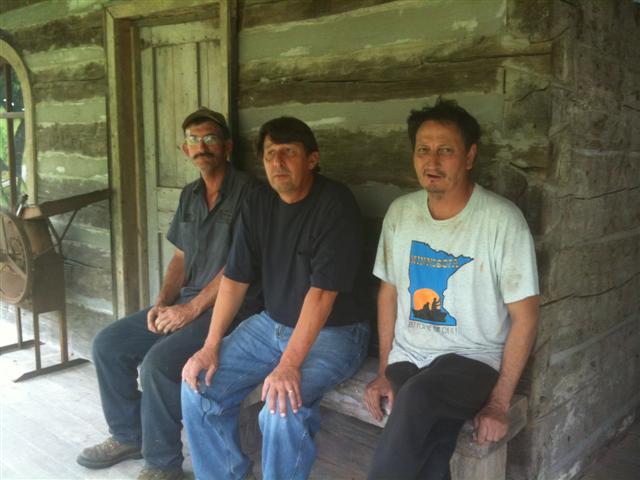
Our visit was made special by the helpful assistance of a couple of volunteers who were there at the cabin, getting it ready for a homecoming day held this past Saturday. My husband, Mike, is seated center, with Mr. Gibson on his right (our left) and David Collins on his left (our right).

Your curiosity about Melungeons may be piqued. Much information abounds on the internet, but the information posted at the Mahala Collins Mullins cabin indicates that although there are several theories about these people, there are no clear answers. Old census records show them as "free people of color" or as "mulattoes" and a popular theory among many Melungeons is that they are of Portuguese ancestry, related to a long-ago ship-wrecked band of sailors. Some folks say that they are from Sir Walter Raleigh's colony at Roanoke, Virginia who mysteriously disappeared around 1560 and lived and intermarried among the Indian tribes further inland. DNA studies seem to indicate a Middle Eastern or Mediterranean ancestry. No clearcut answers have been found, and the controversy over the Melungeon heritage continues, with Newman's Ridge and Vardy Valley being perhaps the most famous of the Melungeon territories.

Mike and I certainly enjoyed our visit to the Vardy community, and if you are ever in the area, might we suggest a leisurely drive from Cumberland Gap to Sneedville via Highway 63, with a side detour to Vardy.

Friday, June 4, 2010

Off they go...


Fessie Pennington with his two oldest daughters ... looks like they are ready to leave for school or some other occasion, matching outfits and all. That's Jo Ann, the oldest, on the left and my mother, Betty Jean, on the right. My mother says that the picture was made when they lived in Smithville, and the building in the background is a smokehouse. I don't think Aunt Brenda was born yet, or she was just a baby.

Thursday, June 3, 2010

Lawrence Tucker, 1910-1978


Mary Williams Dulaney identified this picture of her first cousin, Lawrence Tucker, who was born January 10, 1910. Lawrence was the son of Thomas "Tommy" Tucker and Ollie L. Johnson. Mary and Lawrence were two of several grandchildren of Napolian A. "Poley" Johnson and Mary Lester, along with Olun Dulaney who is mentioned below as an overnight guest of Lawrence. Velma, Olema, Ruby and Onnie Johnson, and Ival Tucker, were cousins out of Napolian's brothers. Families sure were a lot closer back then, weren't they?


Fulton News Beacon
April 30, 1931
Pine Grove
Mr. Onnie Johnson spent Saturday night with Mr. Lawrncie Tucker.
Misses Olema and Ruby Johnson, Miss Ival Tucker, Mr. Larncie Tucker and Mr. Oliver Mitchell were pleasant dinner guests of Mr. Onnie and Velma Johnson Sunday.

Fulton News Beacon
October 15, 1931
Fulton Route 4
Mr. Olun Dulaney spent Saturday night with Mr. Lawrence Tucker.

Wednesday, June 2, 2010

John & Becky Patterson family

John & Rebecca Patterson and Family

John Lindsey Patterson, his wife Alice Rebecca Bourland, and their children, were Cardsville residents of Itawamba County. John's father, Greenberry, was a Georgia native who first settled in Pontotoc County but moved to Itawamba County between 1860 and 1870. The 1870 census for Greenberry Patterson indicates that his neighbors were Bourlands, Wrens and Cautherns - all familiar names found in the Cardsville and Peaceful Valley communities along the western side of the Tombigbee River.

Alice Rebecca Bourland, known as Becky, was the daughter of Robert Hudspeth Bourland, and Elizabeth Hawkins O'Neal, and she was the granddaughter of James S. Bourland, the original Bourland settler of Itawamba County. James S. Bourland, a South Carolinian, and his wife Mary Hudspeth, moved to Monroe County in the 1820s, and when the Chickasaw Cession lands opened up, they bought land in the southern part of Itawamba County near present-day Cardsville. The Bourland family were long-time members of one of the earliest churches in the county, Enon Primitive Baptist Church, which was organized in 1835 and continues to this day.

The photograph of John and Becky Patterson's family was shared by their great-grandson Garry Morris McFerrin of Mantachie. His grandmother, Mary Elizabeth "Bess" Patterson, is the young lady seated in her daddy's lap. Bess married Jury Pennington, and you may remember reading earlier posts about them, most recently about their success in the Plant-to-Prosper Program. Jury was Fessie's (my grandfather) uncle, therefore my great-great uncle.

Standing behind their parents are the twins, and the oldest children, Alice Hardie and Newton Ira, born in 1891. Standing in the middle is their son, Lula Preston Patterson, born in 1898. Another son, Newman, died in 1900 at the age of seven, before this photograph was made. The baby of the family at the time, in her mother's lap, is Rixie Bell. Since she was born in September 1903, this picture was likely made in early 1904. John and Becky's last child, Estelle, was born in in 1908 and thus isn't pictured in the photograph.

A big thanks to Garry for sharing the photograph of his great-grandparents' family!

Tuesday, June 1, 2010

Vida Chesteen Dulaney

Beautiful young Vida Dulaney

Vida Dulaney was a busy young woman in June 1931! A bit of courting was obviously going on because by November of that year, she became the bride of Floyd Wilemon, her fellow dinner guest on a June evening. Vida was the daughter of James Henry "Jim" Dulaney and Laura Bertha Warren while Floyd was the son of Jerome W. Wilemon and Erah Charlotte Beasley. Vida and Floyd made their home north of Fulton on Highway 25 for many years, on Route Number 2.


Fulton News Beacon
June 22, 1931
Fulton, Route 2

Miss Vida Dulaney spent Monday night with Miss Mamie Senter.
Miss Vida Dulaney was the Saturday night guest of Miss Ovalene Robinson.
Messrs Floyd and Earnest Wileman and Miss Vida Dulaney were dinner guests of Miss Ruby Dulaney, Sunday.

Monday, May 31, 2010

Memorial Day - Lest We Forget

My father at Meuse-Argonne Cemetery


During my father's military service in France in the mid-1950s, he and my mother were fortunate enough to tour the area around St. Mihiel where they lived, as well as take a few trips outside of the area to Paris, Nice and to Italy. Daddy was stationed at an army base at Sampigny which was a couple of miles from St. Mihiel. This area of France, known as the Alsace-Lorraine region, see-sawed back and forth between Germany and France for centuries. During World War I, the region was held by Germany but for three hundred years before, it was part of France. Following the war, the area reverted back to French rule. Many ruins and memorials dotted the region when my parents lived there, none from World War II though ,as the area escaped major action during the second war.

The United States didn't enter World War I until April 1917, and it took several months to draft, organize and train troops, as well as to produce the necessary war equipment and supplies; thus it wasn't until 1918 that the U.S. actually sent troops to Europe to aid the Allies in their fight against the German army. By the Spring of 1918, when French and British troops had been depleted and the outlook was bleak, General John J. Pershing's American troops brought much needed support and strength to the Allies. The American troops took the lead in several offensive attacks in the Alsace-Lorraine region, and by September the German troops were in retreat.

My mother took the above picture of Daddy standing over the graves of fallen American soldiers at the Meuse-Argonne Cemetery. The Battle of Meuse-Argonne was, at the time, the largest battle ever fought by U.S. troops in American history. Fought between the Meuse River and the Argonne Forrest, over one million American soldiers participated in this battle, which lasted nearly two months and eventually resulted in an armistice with Germany on November 11th. Originally, this day was celebrated and remembered in the U.S. as Armistice Day but in 1954 the day became known as Veterans Day to honor all veterans. Memorial Day is a similar holiday, a day set aside to to commemorate U.S. men and women who died in military service to our country. It used to be a tradition to observe the Memorial Day holiday by visiting cemeteries and memorials, but most folks these days view the day as part of a three-day holiday weekend.

The Meuse-Argonne Cemetery is the largest American cemetery in Europe. Its 130 acres hold the graves of 14,246 American soldiers who died during this great battle. Each Cross or Star of David is engraved with the name of a fallen soldier along with his unit and state of residence. The names of an additional 954 soldiers whose bodies were never recovered or identified are engraved on a monument within the cemetery.

St. Mihiel, where my parents lived during their stay in France, also was the site of a major offensive during World War I, and it too has an American cemetery honoring the dead soldiers from that battle.

Sunday, May 30, 2010

Evans-Dunn families


The trip to Georgia didn't really turn up any new information on the Evans and Dunn families. Of course, only a small bit of time was devoted to searching for information on these families as the main point of the trip was research for the book on the Dulaney family. However, in researching the Dulaney family of Onslow County, North Carolina for a possible connection to Daniel Dulaney of Pendleton District, South Carolina, I came across some familiar looking names.

When Henry Dunn died in Hancock County in 1799, John Hix (sic) was appointed administrator of his estate. Probate records indicate that following a sale of Henry's personal property, accounts (debts) were paid to "Hinchier Lary" and "Danby Lary". The Onslow, North Carolina records contain a deed dated 1778 to "Darby Lary" that was witnessed by "John Hicks". There is also a 1786 record of a Henry Dunn purchasing 170 acres on the southwest branch of New River in Onslow County, and in 1798 Henry Dunn apparently sells the same 170 acres, probably in anticipation of the move to Georgia. Whether this is "my" Henry Dunn or not, I don't know right now but I am encouraged, especially since the same names - John Hicks and Darby Lary - show up in both Onslow County and in Hancock County in Henry Dunn's estate records.

Saturday, May 29, 2010

Follow-up on the trip to Georgia

Well, Cousin Don and I made it back from Georgia safe and sound. Two days at the Georgia State Archives in Morrow were followed by a stay with Cousins Bobby Gene and Vivian Pennington who live just south of Macon. Macon's public library has an outstanding genealogy and archives section, and Don and I made good use of it while we were staying at the lovely Pennington home. Bobby, Vivian and Kyra were wonderful hosts who spoiled us tremendously - thank you so much for inviting us into your home.

After the days spent at the Georgia Archives and at Macon's genealogy library, you would think we had gathered enough information to do us for a while. You would be wrong. On our way back home, we stopped at the library in Anniston, Alabama in Calhoun County where some of the Dulaneys lived, then at the Birmingham Public Library for a few hours before finally turning the car toward Mississippi late Tuesday afternoon.

Don't know about Cousin Don, but I've been plumb tuckered out since getting back home. In addition to getting caught up with house and yard work, I've been sorting through the information we collected, trying to get it organized before starting the analytical process. We got some great stuff for the book on the Dulaney family, but there is still a lot of work to be done if we hope to find out the parents of Daniel Dulaney of Pendleton District, South Carolina. Thankfully, we picked up some new leads to follow, and Cousin Bobby Gene said to come back any time!

Monday, May 24, 2010

William Evans- Madison County, Georgia

The above image came from microfilm of the records of the Madison County, Georgia Poor School Fund for 1833. William Evans, parent, had three children enrolled in the pubic schools for Madison County: William, age 15; Sarah, age 11; and David, age 8. I feel certain that the fifteen year old William is William M. Evans, my great-great-great grandfather who died in Itawamba County in 1896.

Georgia was one of the first states in the South to establish funds for public school education. In 1822, the Georgia legislature established the "Poor School Fund" which became the state's first step toward a free public school system. Prior to the establishment of this fund, schools were funded primarily by tuition fees paid by the students. Although the "Poor School Fund" was a good idea, the benefits were limited and eventually the legislature discontinued funding. Not all counties took advantage of the funds, but Madison County did and thus William M. Evans received a public school education which served him well in his business dealings in Itawamba County. The 1891 edition of Goodspeed's Biographical and Historical Memoirs of Mississippi stated that William was "given the advantages of a common-school education in his native state" and indeed, he was.

Saturday, May 22, 2010

'Airship' is a no-show


December 3, 1931
Local Happenings

A few weeks ago there was a man came to Fulton and arranged with several here to return later with an airship to entertain a large crowd of people who would be here to see and to ride the plane. He collected one or two dollars for advertising space from each individual or firm who went in with him, then after collecting in advance he headed east and has not been seen or heard from since. He had arranged with Sheriff Pearce for a landing field and all matters had been arranged, but he paid no money out. He received several dollars and that was the last of him. He was in a Whippet car and limped when he walked on what he claimed to be a cork leg.

Friday, May 21, 2010

Evans family, continued


As I left yesterday's post, I was moaning over the difficulty of sorting through all of the Henry Dunns and William Evanses in early Georgia. Cela Dunn Evans' father, Henry, left a personal estate valued at nearly $1,000 in 1800, including cash of $309. In 1804, William Evans signed a receipt to the administrator of Henry Dunn's estate in Hancock County, Georgia, saying that on behalf of his wife he had received $128.48, the amount of her "legacy."

Hancock County was formed in 1793 and was adjacent to lands that formerly were held by Wilkes County. Following the Revolutionary War, there was a period of rapid growth in Georgia as settlers poured in from the Carolinas, Virginia, Maryland and other states. Counties and boundaries were in constant change. In 1811, Madison County was formed from several counties that at one time had been part of lands in Wilkes and Franklin Counties. It is in Madison County that I found the next record for William Evans and his wife Cela.

There are several land records for Thomas, William and David Evans in Madison County. From these records, it appears that our William Evans lived on land along Fork Creek and Holly Creek in the southeastern corner of Madison County. That corner was pulled from Elbert County which previously was part of Wilkes County. It is so important when researching family history to know how the boundaries changed from one period to the next since records can be found in several places.

Also important is knowing the who the neighbors of your ancestors were because these neighbors represented a marriage pool for your family; they often attended church together, sold land to each other, and even migrated to new lands together. Researching these neighbors can often provide clues to your own ancestor's past. Neighbors found near the Evans families in southeastern Madison County were Griffith, Eberhart, McCurdy, Adair, Allen and others.

In 1823, William Evans sold 88 acres on the "waters of Fork Creek" to James L. Griffith, and the deed was witnessed by David Evans, Thomas Evans and John Griffith. The deed abstract indicates that "Celia Evans, wife of William Evans, relinquishes her dower" which means that she was a willing party to the transaction and gave up her wife's interest in the land. I believe that "Celia" was actually "Cela" who was the daughter of Henry Dunn. Other researchers, however, claim the Celia was the daughter of John Leverett whose 1811 will in Wilkes County references his son-in-law, William Evans. I've found no mention of Celia as the name of the daughter of John Leverett and believe that this is a wrong conclusion.

Probable son of William Evans and Cela Dunn, Henry D(unn?) Evans, married Nancy Griffith, daughter of David Hannah Griffith and Nancy Eberthart. Henry named one of his daughters Cela Daymond Dunn, obviously after his mother. He also named his first two sons Charles Thomas Evans and William David Evans.

My great-great-great grandfather, William M. Evans, indicated that his parents were William Evans and Sela Dunn. He named a daughter Sela, a son John Thomas (my ancestor) and a son William. William's brother, Thomas, named a daughter Sela and a son William.

Another clue was found in the Paulding County History & Biography publication. The biography of Henry Bone indicates that his mother was Nancy Evans, daughter of William and "Celia" Evans of Madison County, Georgia. Nancy married Bailey Bone in 1826 in Madison County, and they moved to Carroll County, then Paulding County, Georgia. Paulding is where my William Evans and his brother, Thomas, were both married. A third possible sibling is Caroline Evans, who married James Lee Adair, son of Bozeman Adair, in Madison County in 1838 and moved to Paulding County, Georgia. The ages of these possible siblings all fit the census records for William Evans of Madison County.

The last census record for William Evans of Madison County is 1830. It would seem that he and Cela died before 1840. The young male in their household, under age 5, appears to show up in the 1840 household of his brother, Thomas Evans, as a male age 10-15 years old. Thomas was only recently married, in 1838, and thus this could not be his son. Enumerated next to Thomas "Evens" was his brother and my ancestor, William Evens, as the single occupant of his household. Neighbors of Thomas and William Evans in this 1840 census were William Bone, William Adair, W.S. Adair, and others. William Adair was also a neighbor of William and Cela Evans back in Madison County in 1830.

Evans brothers, William and Thomas, moved to Itawamba County, Mississippi not long after 1840, settling on lands near present-day Tremont and close to the border with Alabama. William died in 1896 and was buried in the old Asbury (Evans-Gilmore) Church Cemetery, now on private land. From what I've been told, the old Asbury Methodist Church burned and a new one was built that now sits on Highway 23 south of Tremont. Thomas moved on to Texas where he died in Itasca in Hill County where many of his children migrated.

Although I am fairly confidant that the wife of William Evans of Madison County, Georgia was Cela Dunn, daughter of Henry Dunn, more research needs to be done. Whether her name was Cela, Sela, Selah or Celia, she must have been a special person for there were many grandchildren and great-grandchildren named after her. Hopefully, some answers will lie in the Georgia State Archives, and if they do, I'll let you know.

Thursday, May 20, 2010

Evans Family


There were at least three sets of Evans families in early Itawamba County. In addition to my own William M. Evans family, I've counted at least two more: the Parrott Evans family who lived near Tilden (actually a bit south of there) and the John Evans/Meeky Crawford family who lived in the northern part of our county, up near Mud Creek and Sandy Springs. John and Meeky are my husband's great-great-great-great grandparents, through their granddaughter, Betty Griffin Thornton.

William M. Evans, and wife Sarah A. Pearce, were both Georgia natives. According to William's biography, which appeared in the 1891 edition of Goodspeed's Biographical and Historical Memoirs of Mississippi, he was born in 1818, the son of William Evans and Sela Dunn. Sarah was the daughter of John Madison Woods Pearce and Elizabeth "Betsey" Skinner. William and Sarah married in Paulding County, Georgia about 1844, according to the biographical sketch in Goodspeed's, and they had seven children together, five reaching adulthood. Unfortunately, Sarah died in 1863 at the young age of 39, probably after giving birth to her last child, William D. Evans (I suspect the middle initial stood for "Dunn" but cannot say for sure). William did not remarry after Sarah's untimely death but instead raised their children by himself.

The land deed records of Itawamba County, as well as scraps of information gleaned from Marion County (that courthouse had several fires, the last one in 1887, with all old records destroyed), indicate that William was a large landowner, and Goodspeed's stated that he owned nearly 5,000 acres in 1891, five years before his death, "the largest amount owned by any one man in the southern part of the county." His in-laws, the Pearces, owned quite a bit of land as well. Sarah's father established Pearce's Mill in eastern Marion County, and her younger brother James Pizarro "Jim" Pearce owned over 30,000 acres at his death in 1915.

William was a self-made man, arriving in Itawamba County around 1846, and it has long puzzled me as to his early beginnings. Working from the only clue I had, the name of his parents given in the Goodspeed's biographical sketch, I've spent a lot of time trying to learn more about him and the rest of the earlier Evans family. William didn't come to Itawamba County alone - his older brother (by seven years), Thomas was actually here first, arriving by 1844 when he purchased a 160 acre tract of land jointly with Jacob Floyd Martin, his wife's brother-in-law and a minister who is generally credited with the founding of Mt. Pleasant Methodist Church near Tremont. Thomas married Henrietta Adair Clayton, daughter of Middleton Clayton, on June 11, 1838 in Paulding County, Georgia. After Henrietta's death sometime before 1873, Thomas moved to Itasca in Hill County, Texas where he died about 1889.

In addition to William and Thomas, I've identified at least one other brother, Henry D. Evans, who remained in Georgia and raised a family in Walton County. Henry's middle initial "D" is undoubtedly for "Dunn", and he named sons William and Thomas, and named a daughter Cela Dunn Evans. Henry's wife was Nancy Griffith, daughter of David Hannah Griffith and Sarah Eberhart. By researching Henry and his family, I've been able to pinpoint other clues as to the heritage of William M. Evans.

An important discovery was made when I found estate records for Henry Dunn in Hancock County, Georgia. Henry died without a will on January 30, 1800, and his personal estate was sold the following month for support of his widow, Nancy, and for division among his heirs. In neighboring Wilkes County in May 1800, "Celia Dunn, orphan of Henry Dunn, dec'd" requested that Purnal Truett be appointed her guardian. Sometime between 1800 and 1804, Celia, or Cela, married William Evans for in August 1804, William Evans signed a receipt for his wife's "legacy, being one of the heirs" of Henry Dunn, deceased. Other heirs were Susannah Dunn, who later married Athelston Gupton in 1818; William Dunn, possibly married to Rhoda Ransom; and Henry Dunn, Jr. of which nothing is known.

The difficulty in researching the Evans and Dunn families in this area, during this period of time, is that there were several with the same name..... numerous William Evans and several Henry Dunns.... and it is hard to keep them straight, especially when fellow researchers have claimed this William or that Henry as "their own" when records might not necessarily support their "claim."

Part Two continued tomorrow....